Monthly Archives: August 2009

Impressions from OpenSourceWorld 2009

IDG’s LinuxWorld (LW) was renamed to OpenSourceWorld (OSW) this year. Two other IDG conferences CloudWorld and Next Generation Data Center were co-located with OpenSourceWorld at Moscone West. Interest in what was once LW’s expo (now OSW’s solutions showcase) and curiosity about how the re-branding was working led me to attend the event last week.

As in past conferences, IDG did a great job with the infrastructure (stages, presentation, A/V etc.) as well as the new solutions showcase. However even an upscale venue such as Moscone West could not hide the effects of the current economic downturn. Particularly obvious was the lack of crowds.

First stop: Conference Sessions

At the conference sessions, I expected to hear about new ideas in business models and activities around open source. I was disappointed. The talks and panel discussions lacked depth. The keynotes suffered as well. The Dell keynote speaker was substituted at the last minute and seemed unprepared.

Next stop: The Solutions Showcase

Open Source World 2009, San Francisco

Open Source World 2009, San Francisco

This year’s expo was trimmed down to a solutions showcase featuring vendors from three market segments – open source, cloud computing and data center. The shortened timings (an hour at lunch and a couple of hours in the evening) might have been intended for maximizing crowd coverage between sessions and the show floor but turned out to be pretty inconvenient for many attendees, giving them little time to connect with exhibitors. However once the show floor opened and the evening reception started, the pretzels and drinks helped get conversations flowing.

Final stop: The Invisible Dot Org Zone

No open source conference is complete without the healthy participation of dot org projects. But here at OSW they were invisible! Well almost. After asking around at the FreeBSD booth which was surprisingly located on the main show floor, I found the projects tucked away in a separate room at the back of the showcase hall. This (mis)placement was unfortunate and doesn’t represent the open source world which thrives on technology from all sectors, commercial and non-commercial alike. Hopefully, IDG will consider having all exhibitors in the same area next year.

Any business conference can only be successful by virtue of the real value it brings to its participants – the sponsors, exhibitors, speakers as well as attendees. Perhaps, re-branding and co-locating multiple conferences, in the face of a bad economy, diminished a compelling value for any of its participants.

Hoping for a better OSW next year!

At IPDC3 with Dom Sagolla

“Building Teams, Polishing Ideas, Creating Truly Compelling Demos”

iPhoneDevCamp 3

iPhoneDevCamp 3

Dom Sagolla has been a key mover of the iPhoneDevCamp movement since day one. It’s been impressive to have Dom’s energy, enthusiasm and ideas take the iPhoneDevCamp to next level. Throughout the DevCamp, Dom was hard at work, helping folks as well as making progress on his upcoming book. Here are Dom’s responses to some questions I had for him at the camp this year.

  1. The iPhoneDevCamp model offers a winning formula for community collaboration events. It is likely that other technology communities may be able to use this model. What would be your advice to them?

    It’s already begun with things like AndroidDevCamp, PreDevCamp, and now “WinMoDevCamp“.

    My advice is always this: Make the event all about the participants. When you focus on building teams, polishing ideas, and creating truly compelling demonstrations, you are following the model of BarCamp.

  2. A 10 year old developer won applause as the youngest participant at the DevCamp this year. How do you see the camp inspiring kids in school and in general?

    10-year-old Annika has my favorite story this year. Having been dragged along to last year’s event, she made the best of it by reviewing the apps of other participants. This year, she’s created @KidGameReviews and started developing her own games! Annika shows us just how easy it is to get started with iPhone Development. She’s still learning but the growth I’ve witnessed over the past year, in her and in the community, is inspiring.

    iPhone is a lens, through which the problems of computer science may be examined. I hope kids of all ages get a chance to play with Apple’s superb example code just to see what’s possible in a few days’ time.

    Every year we sponsor a few student participants at iPhoneDevCamp, and we will certainly continue that tradition. Perhaps we’ll add to this a new category of “Youngest iPhone Developer”.

  3. Some apps such as Avatar Wall, winner in Coolest iPhone App category, used Twitter to demonstrate their ideas. What do you think is the impact of social networking services such as Twitter on the type of apps being developed?

    Twitter is becoming a communication utility, like other service providers online and in our homes. Seeing the Twitter API in use at iPhoneDevCamp is another sign that social networking is now a fixture in our lives.

    iPhone was launched just when Twitter began to gain prominence two years ago. There has been a complimentary arc of growth for both Apple and Twitter since then, and Twitter was profiled as an “Apple Business“.

    I see the intersection of iPhone and Twitter as a kind of cultural nexus. The best of breed Twitter apps are on the iPhone / Mac platform, and the most virulent iPhone apps integrate well with Twitter and other social media. The two platforms combined create a vortex of attention and zeal that is driving innovation on both ends.

  4. How does a community event like the iPhoneDevCamp that has grown in popularity every year fit into the iPhone developers ecosystem? How does it complement official (e.g. by Apple) and unofficial (e.g. barcamps) activities?

    I like to think of iPhoneDevCamp as a “sister event” to WWDC. Folks go to learn new technologies and talk with Apple engineers at WWDC. Inevitably they are inspired and want to test their knowledge, so we have created iPhoneDevCamp where they can form teams and build things.

    The relationship is complimentary: We do our best to schedule around Apple’s events, and stay in contact with them at an informal level.

    In the BarCamp tradition, we want to be a model for other Open Source communities to band together, find sponsorship, and field events of their own. I think the Satellites program launched for last year’s iPhoneDevCamp, with double the participation this year, pretty clearly shows our commitment to the BarCamp way.

  5. Your writing project “140 Characters: A Style Guide for the Short Form” sounds exciting. Is there going to be a chapter about using Twitter at the iPhoneDevCamp? You mentioned you’d be gathering some source material for the book at the DevCamp. Did you notice anything interesting about how Twitter was being used by the participants (and organizers)? Tell us more.

    140 Characters: A Style Guide for the Short Form

    140 Characters: A Style Guide for the Short Form (flickr:Sagolla)

    I do talk about iPhoneDevCamp in “140 Characters”, yes! Our use of #ipdc3 as a tag this year, as well as a few choice quotes from our performer @BT are profiled: http://bit.ly/140-chars.

    iPhoneDevCamp itself formed out of the Twitter community. @Ravenme wrote to @ChrisMessina who posted an inquiry for space, which I picked up because I’d just started following Chris in mid-2007. I replied in public to Chris, he followed me back and the rest is a history of 100% year-on-year growth.

    Twitter accelerates small societies.

    We did an experiment this year, where we made our Satellite broadcast available via iPhone and iPod touch for the first time. Tweeting that link resulted in about 1000 viewers around the world. That’s how I measure reach: How many people are tuned into your message RIGHT NOW?

    I measure impact with action: in the last days of Registration for the camp, we sold out three (3) times. Each time capacity was lifted, we tweeted the Registration link and we were sold out again within hours.

    The Twitter community is voracious for learning and real-life connection. Tapping into that has been critical to the success of iPhoneDevCamp and the iPhone Developer community abroad.

  6. What can we expect at DevCamp 4? Any surprises coming up?

    Next year: iPhone Jam Band! :-D

    Seriously we haven’t talked about plans for next Summer yet. Right now is the time to follow up with all the Satellite communities and see how we can enable more events elsewhere during the year.

    We would be thrilled to work with Yahoo! and all of our sponsors again next year, which we know will be yet again bigger.

Dom Sagolla

Dom Sagolla (flickr:Sagolla)

Dom Sagolla helped create Twitter with Jack Dorsey in 2006 then co-founded iPhoneDevCamp with Raven Zachary in 2007 (just a week after the launch of the original iPhone). After helping Raven and the team create the Obama ’08 iPhone App in 2008, Dom started his own company DollarApp in San Francisco, resulting in two Staff Favorites: Big Words and Math Cards. @Dom’s book “140 Characters: A Style Guide for the Short Form” is the subject of his next iPhone invention, shipping this Fall.

A Conversation with Christopher Allen

iPhoneDevCamp 3

iPhoneDevCamp 3

I have had the pleasure of seeing Christopher Allen in action at the iPhoneDevCamp since its inception in 2007. Chris has been a superb mentor and open source guru for the iPhoneDevCamp hackathon every year. I’ve felt the energy that this DevCamp hackathon has generated from everyone sharing the experience of building applications together. Here are some questions I asked him after this DevCamp’s phenomenal success. Hope you’ll enjoy reading his responses!

IPDC3 Team

IPDC3 Team

  1. What were your expectations from the iPhoneDevCamp this year? Did the camp meet your expectations?

    Last year’s hackathon was a great success, in spite of the SDK being so new we were able to demonstrate over 40 iPhone applications. This year we had 54 apps demonstrated, many of which showed the results of a year’s worth of experience in developing for the SDK. The other big problem last year was the NDA, which prevented sharing — this year I was quite pleased with the number of open source entries, which allows people to learn from others and/or improve. Finally, I really liked the number of designers and non-programmers who participated on teams last year, and I was a little worried that they would be shut out given the popularity of iPhone — yet we continued this year to have a number of teams led by designers and teams made up of programmers new to the iPhone.

  2. Do you see the DevCamp growing, getting smaller, or is it just right?

    I write about group size in my blog at www.LifeWithAlacrity.com, so I am certain that iPhoneDevCamp will lose something if it grows too big. One thing that could be lost is the ‘amateur’ component that is so valuable — especially given the origin of the word ‘amateur’ is ‘to love’ the lack of amateurs could lead a certain lack of passion. Amateurs also are less likely to fall into traps of “it can’t be done” or “it can’t be profitable” and just make something new happen because they don’t know their limits.

  3. Which applications did you find most intriguing and innovative from the hackathon?

    Quite a few, but I think the Augmented Reality library might see the most use by other application developers. I was also inspired by the father teaching his daughter to make the Bubblo application.

  4. Collaboration, community and coding are core themes of the iPhoneDevCamp hackathon. Can you tell us about a few examples you saw at the DevCamp that demonstrated these themes.

    More completely, the list is Contribution, Sharing, Openness, and a “Can Do” attitude. I started giving out tickets Friday evening and Saturday morning when I saw people coding or showing others their code during “outside hours” when other stuff was going on. I gave tickets out when someone would answer a call for help on code, or an icon, etc. I would ask each team what person outside their team helped them most, and then go find that person to give them a ticket. Finally, I gave few tickets out when I spotted obvious signs of enthusiasm and happiness.

  5. With the iPhone being a tightly controlled platform by Apple, how do you see open source apps fitting in?

    There were a few others at the conference (in particular some of the staff from Yahoo) who have had experience with other Hackathons which were more open source oriented, and they definitely felt a different vibe due to the commercialism of the iPhone. In my own experience with MacHack and the prior iPhoneDevCamp, open source on the iPhone is much more about teaching and learning rather then sharing and contributing to the commons.

  6. What do you see will be the impact of new technologies like HTML5 on the iPhone?

    Clearly 5 years from now you can probably do 90% of the apps today for the iPhone using open technologies like HTML5. In fact, that is the basic premise of the Palm Pre. However, we are not quite there yet, and Microsoft will continue to stall and slow the process of open technologies and we will just have to route around them.

Photo Credit: Christopher Allen

Photo Credit: Christopher Allen

In his own words, Christopher Allen “is an long-time entrepreneur, visionary, and technologist, whose many ventures center on tools and facilitation of online communities. He helped invent SSL and is co-author of the IETF TLS internet-draft, is an investor and advisor to a number of social software and online game companies, and blogs at www.LifeWithAlacrity.com. He is co-author of “iPhone in Action: Introduction to Web and SDK Development”, is the founder of the www.iPhoneWebDev.com, the largest iPhone web developer support community, is maintainer of iUI at iui.googlecode.com a popular iPhone Javascript library, and is keynote speaker and co-founder of www.iPhoneDevCamp.org where he moderates the popular Hackathon Contest.”

iPhoneDevCamp 3 ends with a roar: 54 apps showcased!

iPhoneDevCamp 3

iPhoneDevCamp 3

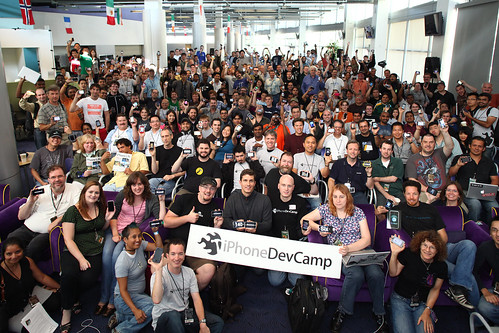
What a weekend at iPhoneDevCamp 3! Community and friends coming together to collaborate, hack code, enjoy great food and soak in the picture perfect weather at Yahoo’s beautiful campus – what else could an open source geek ask for? Here is the group photo of everyone who participated this year.

I thoroughly enjoyed the Dev Camp this year- there were some excellent talks on Saturday. There was plenty of time for hacking and the results of the hackathon were paraded out on Sunday afternoon. Open source and web applications hacked together over the weekend were showcased. Other apps included alpha versions of future App Store products. More than 60 apps were entered for the hackathon and 54 of these were were showcased in the demo session. Chris Allen, guru and mentor for the hackathon along with other judges watched each demo with great attention and afterwards announced the winners in each app category. The winners are listed here.

My congratulations again to Raven Zachary, Christopher Allen and Dom Sagolla – the key movers for making this Dev Camp happen. And thanks to Yahoo! for providing a fantastic venue for everyone to gather and build some innovative web and native iPhone apps. Looking forward to iPhoneDevCamp 4!

iPhoneDevCamp 3 gets off to a running start

iPhoneDevCamp 3

iPhoneDevCamp 3

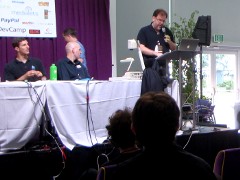
The third iPhoneDevCamp kicked off Friday evening at Yahoo!’s scenic campus with an enthusiastic audience and an excellent talk by Chi Hua-Chien’s session on iFund, Kleiner Perkins’ venture fund for iPhone applications. Today started with a great  presentation by Andrew Stone on ‘How the NeXT Computer Became the iPhone’. There are at least 400 people now, forming groups to develop their apps. Some are  listening to BT, the current speaker who is a musician and DJ who is presenting his iPhone app Sonifi that allows users to remix music. Sonifi also has in-built stutter gestures using the iPhone accelerometer. You can stretch these stutters to extend sections of music which makes it sound metallic. Interesting stuff! After this session, a pizza lunch and four parallel sessions of talks on web and native development tools and techniques are coming up. Time to get back to work on our app for the hackathon!